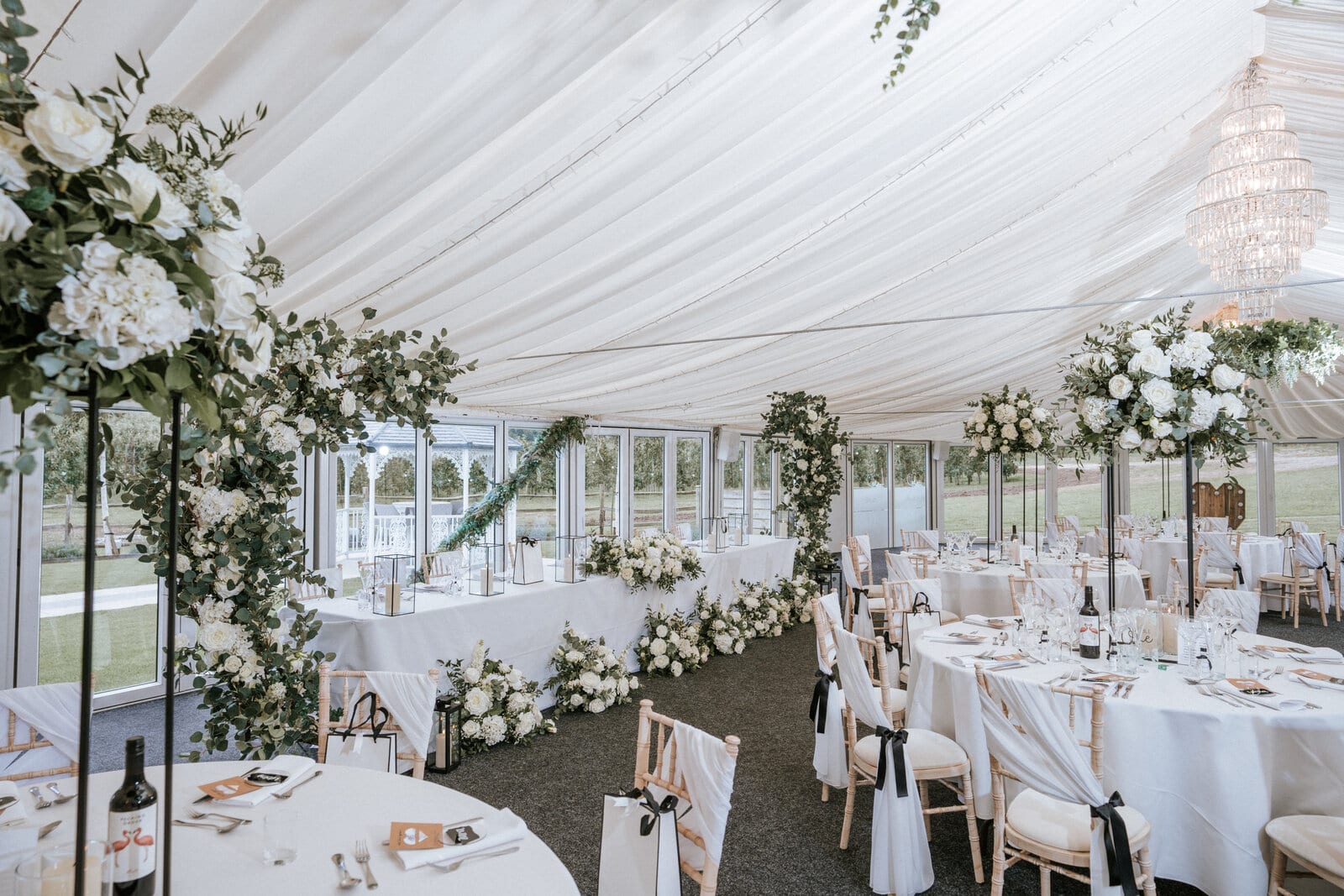
A venue viewing goes quickly. You arrive, someone lovely walks you round, the rooms look beautiful, and forty minutes later you are back in the car realising you never asked what happens if it rains. Most couples view a handful of venues in the space of a few weeks, and the ones who choose well are rarely the ones who saw the most. They are the ones who turned up prepared. Here is how to do that, followed by the checklist itself.
Before you goHow to prepare for a viewing
How should you prepare for a viewing?
Book the viewing properly rather than dropping in, so the right person is free to walk you round and answer questions. Come with two numbers roughly agreed between you: your guest count, split into daytime and evening, and the budget you would genuinely be comfortable spending. Almost every answer a venue gives you means something different depending on those two figures.
Look at real photos before you visit, so viewing time goes on questions rather than orientation. For The BarnYard that is The Collection, our gallery of real weddings in every space. Try to see your shortlist within the same few weeks, because memories of rooms fade fast and comparisons get unreliable. And if a venue runs open days, go to one: a venue dressed for a wedding tells you far more than an empty room. Ours are free to attend, and the details are on our wedding open days page.
Two companion reads, each worth ten minutes before your first visit: our full guide to the questions to ask a wedding venue, which goes deeper on every item below and answers each one honestly for The BarnYard, and, if barns are on your shortlist, our guide to rustic barn wedding venues in Kent, which covers the barn-specific checks.
Print this page or screenshot the lists below and tick items off as you walk round. Nobody at a good venue will mind. If anything, a couple with a checklist gets straighter answers.
Walk every roomThe spaces
- Stand in every room you will actually use. Photos flatter, and your own feet are the only honest judge of size, light and warmth.
- Ask for the seated capacity with the dance floor down. Headline numbers are often the standing evening crowd.
- Ask what the space looks like in your month. Venue photography is nearly always taken in summer.
- Check the heating. Fully heated and heaters available are very different answers in February.
- Walk the route between ceremony, drinks and dinner. Long walks and awkward transitions quietly eat into the day.
- Ask exactly what is exclusively yours. Find out what other events or visitors could be on site, and how they are kept apart.
- Note what is already beautiful. Fairy lights, beams and chandeliers in place are styling you never have to hire.
Saying I doThe ceremony
- Confirm the venue is licensed for civil ceremonies. A licence means marrying and celebrating in one place, with no convoy between the two.
- See every ceremony setting, not just the showpiece. The one they show last is sometimes the one you fall for.
- Stand in the wet-weather room. Only book an outdoor ceremony once you would also be happy with its indoor backup.
- Ask who books the registrars and what their fee is. Someone must handle the legal side, and it is better if it is not you.
- Ask about music and a PA for the ceremony. Outdoor vows need help to be heard on the back row.
- Check the ceremony capacity separately. It is set by the licence and can differ from the dining capacity.
From the kitchenFood and drink
- Ask who cooks the food, and where. An on-site kitchen and an outside caterer make very different days.
- Ask if you can taste before you commit. Menus read well on paper; tasting is knowing.
- Raise dietary requirements now. The answer should be an easy and immediate yes.
- Get the included drinks in writing. Know exactly what reaches each guest's glass, and when.
- Ask the corkage question. If you can bring your own bottles, learn the fee; if you cannot, learn what the bar charges.
- Check the evening food covers your real evening numbers. A buffet for half the crowd feeds half the crowd.
- Ask if there is a cake-cutting fee. A classic quiet extra, and the right answer is a plain no.
The honest numbersThe money
- Get a full written quote for your date and numbers. Verbal ballparks have a way of growing by the contract stage.
- Ask what exactly the price includes. Two identical headline figures can cover wildly different lists.
- Understand the payment schedule. Know every date money leaves your account between booking and the wedding.
- Ask what is refundable, and what happens if you postpone. Far better learned now than in a difficult year.
- Check the pricing for children. Little guests are often free or half price, but usually only if you ask.
- Hunt the quiet extras. Late bar fees, supplier charges and overtime should all be volunteered upfront.
- Confirm prices include VAT. Twenty per cent is a horrible surprise to find late.
After darkThe evening
- Ask what time the music stops. The venue's licence decides your last dance, not your DJ.
- Price a late extension now. If you might want one, find the cost before the night, not during it.
- Check the rules for bands and DJs. Most venues require public liability insurance and PAT-tested equipment.
- Plan how guests get home. Ask about taxis and nearby hotels before your guests have to.
- Ask about confetti, sparklers and candles. Every venue has rules, and it is cheaper to learn them before you buy two hundred sparklers.
- Find out who runs the evening. Someone should be keeping the day to time so that you never look at a watch.
The small printPractical details
- Check the parking. Somebody has to be the guest who parks half a mile away.
- Ask where you get ready. Dressing rooms on site remove a whole layer of morning logistics.
- Check accessibility honestly. Step-free routes and accessible toilets matter to more of your guests than you might think.
- Ask about dogs. If yours is part of the day, get the arrangement agreed early.
- Meet the person who will look after you. Ask if the person showing you round will be there on the day itself.
- Ask when final details are confirmed. Knowing the deadline makes the last months far calmer.
On the drive homeAfter the viewing
What should you do straight after?
Write your notes in the car before you pull away, while the rooms are still fresh, and score every venue against the same list. It sounds unromantic, and it is the kindest thing you can do for your future selves, because after three viewings the details blur and the venue with the best flapjacks starts winning arguments it should not.
Should you go back a second time?
If a venue stays in the running, ask for a second visit, ideally when it is dressed for a wedding or at a different time of day. Light changes a room completely, and so does seeing it full of chairs and flowers rather than empty.
Then pay attention to the feeling. The checklist keeps you honest, but it does not make the decision. Most couples describe simply knowing, somewhere between the car park and the first room, and the list exists so that the knowing survives contact with the paperwork.
You are very welcome to bring every item on this page to us. Viewings at The BarnYard are relaxed, unhurried and easy to arrange through our enquiry page, and if you like your homework done early, most of these questions are already answered in writing on Everything Explained.
Quick answersCommon questions
What should you take to a wedding venue viewing?
This checklist, a rough guest number, a rough budget and your preferred season. Those three numbers narrow every conversation, and without them a viewing goes round in circles.
How many venues should you view?
Three is usually enough, and more than five tends to muddy rather than clarify. Try to see them within the same few weeks so the comparison is fair.
What time of day should you view a venue?
Ideally at roughly the time of day your wedding would happen. A barn at eleven in the morning tells you very little about how it feels at eight at night.
What is the most important question to ask?
Whether the space is exclusively yours, and if not, what else is happening on your date. Venues answer this very differently and the answer changes the whole day.
Should you book a viewing or just turn up?
Book it. A booked viewing means somebody is expecting you and can show you the spaces properly. Open days are the alternative if you would rather look round with no appointment.
What should you ask about wet weather?
Ask to stand in the wet-weather space rather than be told about it, and ask when the decision to move indoors is made. The right answer is on the day.
What questions do couples forget to ask?
Cake cutting charges, whether evening food is included, what the payment schedule looks like, and how guests get home. All four cost money or cause stress later.
Can you bring this checklist to The BarnYard?
Yes, and you are very welcome to. Every question on it has an answer here, and we would rather you asked all of them than none.
Written by The BarnYardat Upchurch, Kent