Search for a rustic barn wedding venue in Kent and you will find pages of places that look, in photos at least, remarkably alike. Oak beams, festoon lights, a couple in a field at golden hour. The photographs are lovely and almost useless, because the things that decide how the day actually feels rarely appear in them: how the barn is heated in February, where everyone goes when the sky opens, and what the headline price quietly leaves out. This is a guide to the comparing stage, written to be useful at every barn venue you visit.
Cards on the table first. The BarnYard is one of the venues those searches return. We are a family-run venue on a fruit farm in Upchurch, established in 1984, and weddings here happen in a converted barn and a glass garden pavilion. So we have an interest, and you should read us the way you would read any venue with one. But every check below applies just as much to us as to anyone else, and we would rather you turned up armed with all of them.
One label, many venuesWhat a rustic barn venue actually is
What counts as a rustic barn venue?
Rustic barn covers at least four quite different kinds of venue, and the differences matter far more than the shared aesthetic. There are working farms, where the wedding shares the site with real agriculture and the setting is as authentic as it gets. There are converted barns, historic buildings rebuilt for events with proper heating, plumbing and kitchens. There are permanent purpose-built spaces, pavilions and garden rooms designed for celebrations from the start. And there are temporary structures, marquees and tipis pitched in a farm field for the season, often marketed with the same barn imagery as everything else.
None of these is the wrong choice. A tipi in a meadow can be magical in July, and a poorly lit Victorian barn can feel gloomy in any month. The point is to know which one you are actually buying, because the experience, the risks and the running costs are different in each case.
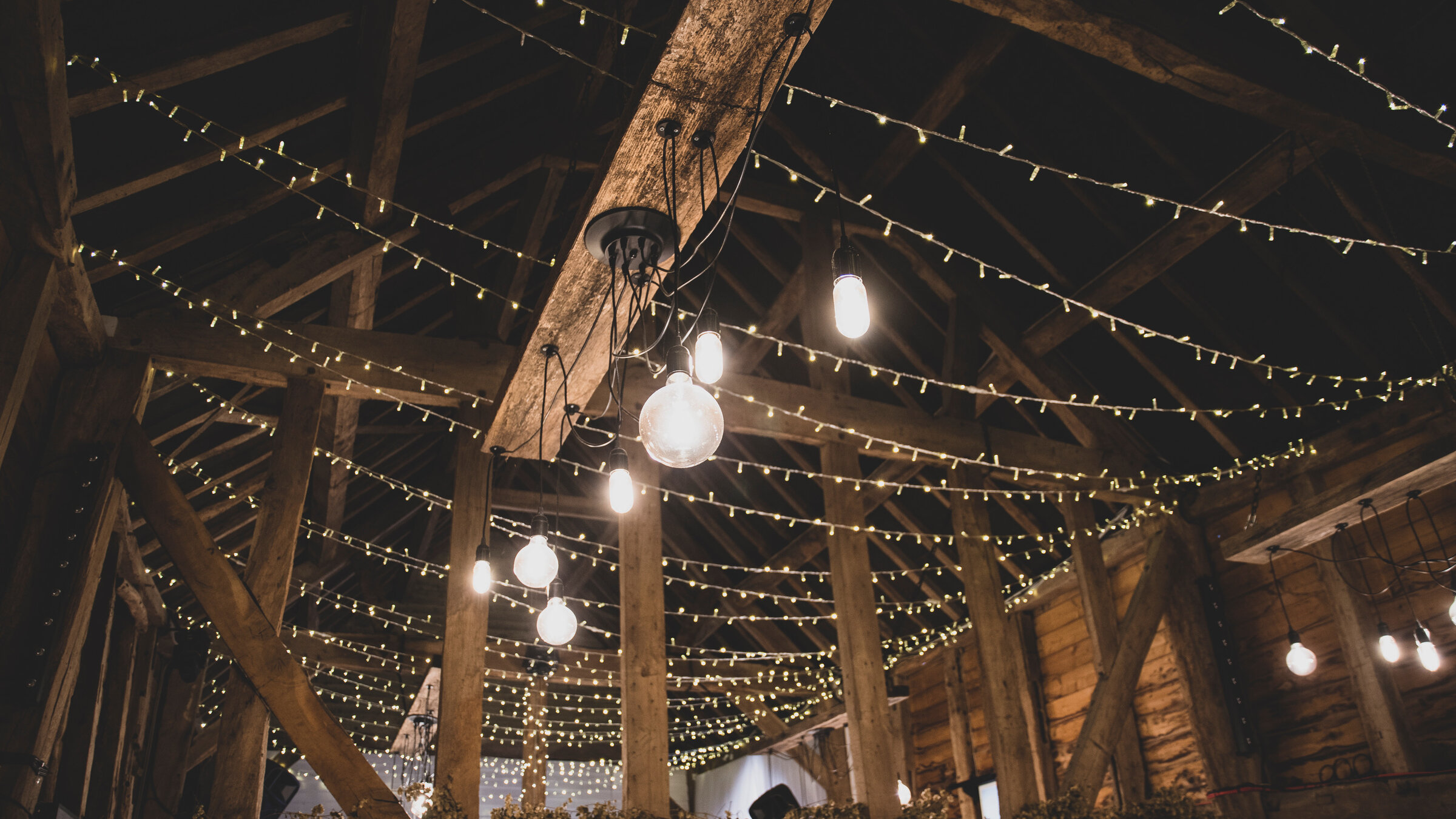
For honesty's sake, here is how we describe ourselves. The Apple Barn is the converted barn: original oak beams, thousands of fairy lights and room for up to 180 guests. The Arboretum is not a barn at all. It is a permanent glass pavilion in the gardens, seating up to 200 for a wedding breakfast, and we call it a pavilion because that is what it is. Any venue should be able to tell you as plainly what each of its buildings really is, and it makes a fair first test.
The February testHeating, and what barns get wrong in winter
Are barn venues warm enough in winter?
Barns were built to store grain and shelter animals. They were never designed to keep a room full of guests in eveningwear comfortable on a January night, and some conversions still have not solved it. Venue photography is nearly always shot between May and September, so the question to ask is simple: what is this room like in February?
Listen for the difference between heated and heaters available. A properly converted barn has fixed heating that copes with doors opening and closing all evening. A space relying on patio heaters and a basket of blankets is asking your guests to dress for the conditions. If you are marrying between October and April, try to view in the cold months, with the heating on, and stand there long enough to know.
Our own answers, for the record: the Apple Barn is fully heated, and the Arboretum was built as an all-season space, with glass doors that close snugly against the weather. In December it is dressed for Christmas and works exactly as it does in June. That is the standard worth holding every barn venue to, not because every venue must be ours, but because your date should not have to fit around a building's limitations.
When the sky opensThe wet-weather plan
What is a good wet-weather plan?
Kent is generous with sunshine and guarantees none of it, in any month. Every outdoor ceremony needs a wet-weather plan, and the difference between a good venue and a stressful one is how specific that plan is. We will sort something is not a plan. Ask exactly where the ceremony moves, how many it seats there, who makes the call and by what time on the morning.
Then comes the part most couples skip: stand in the wet-weather room and ask yourself honestly if you would be happy marrying in it. You are not choosing it, you are underwriting it. At The BarnYard a gazebo ceremony moves to the dedicated ceremony area inside the Arboretum, with the orchard views kept through the glass, while Apple Barn and Courtyard ceremonies have the barn itself as their shelter, and you are welcome to stand in that room on a viewing so the decision is made calmly, months in advance.
Do the numbers hold up?Real capacities against marketing numbers
Are the capacity numbers real?
Capacity is where barn venue marketing gets most creative. The number on a website is often the standing evening crowd, squeezed to the walls, not the number that sits down to dinner with a dance floor in the room. The same building can honestly be described as a 120 venue and a 200 venue depending on which figure you are given.
Ask for three numbers, in writing: seated for the ceremony, seated for the wedding breakfast with the dance floor down, and the total the venue will hold in the evening. Ask about minimum numbers too, because many venues have them and not all volunteer it.
Ours, plainly: the Arboretum seats up to 200 for the wedding breakfast, with up to 100 more joining in the evening. The Apple Barn holds up to 180. Ceremonies are licensed for up to 200 guests depending on the setting, and are conducted by the Kent Registrars. And if your list is closer to 20 than 200, that is a different package rather than a lesser wedding: our Intimate weddings host up to 30 guests.
Canvas or timber?Is the barn actually a barn?
Is the barn actually a barn?
A surprising number of barn wedding venues are, on inspection, a marquee beside a barn. The barn appears in the photography and the name; the wedding happens under canvas. Others use tipis or stretch tents that come down entirely for the winter.
Temporary structures are not a con. Some are beautiful, and for a warm-month wedding one can be exactly right. But they behave differently in wind and cold, they can mean portable toilets and generator power, and if the structure is seasonal, your winter date may be in a building you have never seen. So ask directly: is the space we are standing in permanent? Is it licensed for ceremonies? Will it be here, identical, on the date we are booking?
We hold ourselves to the same question. The Arboretum's soaring white roof means people occasionally ask if it is a tent. It is not: it is a permanent, fully heated pavilion with solid floors and glass walls, licensed for ceremonies and open all year round. You can judge it against real weddings in The Collection, our gallery of every space, which is exactly the evidence we would ask any venue on your list to show you.
Who cooks, who poursCorkage, catering and the bar
Who cooks the food and runs the bar?
Barn venues split into two business models, and the split changes your budget maths completely. Dry hire venues charge for the building and leave you to arrange caterers, a bar, furniture and staff. All-inclusive venues price the day as a package. A dry hire fee always looks cheaper on the first email. Sometimes it still is by the end, often it is not, and the only way to know is to price the whole day, not the hire.
Questions worth asking anywhere: who actually cooks the food, and where? A barn with no kitchen usually means a catering tent behind it. Can you taste the menu before you book? What does corkage cost if you bring your own wine? Is there a charge to cut the cake? Small lines on a quote, but they add up to hundreds.
We run both models, which is less common. Our packages are the all-inclusive kind: everything cooked on site by our own kitchen team, with the Traditional package from £6,750 covering canapés, the wedding breakfast, drinks and evening food, and Twilight weddings from £3,450 venue hire with catering priced separately. We also offer dry hire of The Arboretum on dates inside the next twelve months, for Indian and other ethnic menus brought in by a specialist caterer, with the furniture, the setup and the ceremony licence included and western menus still cooked by our own kitchen.
The bar is the one thing that does not change between the two. Drinks come from our licensed bar on every booking, outside alcohol is not permitted, and a corkage line never appears because there is nothing to cork. Every fee we charge is listed before you book, and Everything Explained answers the awkward money questions in one place. Ask any venue for the same in writing.
Like for likeHow to compare barn venues fairly
How do you compare barn venues fairly?
Once your shortlist is down to two or three, compare them on the same inputs. Same guest count, same month, same day of the week, and the total cost of the whole day rather than the headline. Read what each quote includes rather than what each quote costs, because a £7,000 package covering food, drink and furniture can comfortably beat a £4,000 hire fee that covers a key to the door. Compare exclusivity like for like too: some venues are yours entirely, others share a larger site, and both can be right at different prices. Full private hire of our whole estate is its own package, the Signature, priced on request.
Then see each venue in person, ideally within the same few weeks so your memory can compare honestly, and take the same list of checks to every viewing. We have written a wedding venue viewing checklist you can print and carry with you, and it applies to every venue in the county, not just this one.
If your search started around the Medway towns, we have also written honest local guides for couples looking for a wedding venue near Rainham and Gillingham and a wedding venue near Sittingbourne, both a short drive from us in Upchurch.
Barn weddings earned their popularity honestly. Timber, orchard light and a building with a past give a day a warmth that a hotel function room has to work very hard for. Just make sure the venue underneath the fairy lights stands up to the questions above. If you would like to put ours to the test, explore weddings at The BarnYard or book a viewing, and we will answer everything here in person, February heating included.
Quick answersCommon questions
What is a rustic barn wedding venue?
The label covers at least four quite different things: a genuine converted agricultural barn, a purpose-built venue in barn style, a permanent marquee or pavilion, and a temporary structure such as a tipi. None is the wrong choice, but they behave very differently in winter and cost differently to hire.
Are barn wedding venues cold in winter?
They can be, because barns were built to store grain rather than to hold people. Listen carefully for the difference between a venue that is heated and one that has heaters available, which is not the same promise.
What should you ask about the wet-weather plan?
Ask to stand in it. Not to be told about it, but to physically stand in the space your ceremony would move to, and decide whether you would be happy if that were the plan from the start.
How do you check a venue's capacity is real?
Ask for three numbers in writing: seated for the ceremony, seated for the wedding breakfast, and total including evening guests. Marketing tends to quote the largest of the three.
What capacities does The BarnYard have?
The Arboretum seats up to 200 for the wedding breakfast and takes up to 300 including evening guests. The Apple Barn holds up to 180, and the civil ceremony licence covers up to 200.
Is corkage normal at barn venues?
It varies with the business model. Dry-hire venues often charge corkage or require approved suppliers, while all-inclusive venues usually do not allow outside alcohol at all. We sit slightly outside both: our bar runs every event, including on a dry hire, so there is no outside alcohol and no corkage either way.
Who cooks the food at The BarnYard?
Our own kitchen, on site, on any of our packages. The same kitchen runs the daytime restaurant, so you can taste its cooking before you book. On a dry hire of The Arboretum you can bring in a specialist caterer for an Indian or other ethnic menu; western food stays with our own kitchen.
How many barn venues should you view?
Three is usually enough, and seeing them within the same few weeks makes comparison far easier than spreading visits across a year.
Written by The BarnYardat Upchurch, Kent