
Every couple planning an outdoor ceremony asks the same question and almost nobody gives them a number. So here is one. Using Met Office averages for East Malling, the nearest published Kent station, even July, the driest month of the year, sees rain on roughly 24 per cent of days. There is no month in Kent where you can plan on being dry.
That sounds discouraging and it is not meant to. The point is the opposite: since no month is safe, choosing your date for the weather is a weak reason, and what actually matters is having a wet-weather plan you would genuinely be happy with. Get that right and the forecast stops being frightening.
The numbersWhat Kent actually does, month by month
These are Met Office long term averages for East Malling across 1991 to 2020. A "rain day" is their definition: a day with 1mm of rain or more.
| Month | Avg high | Rain days | Chance of a wet day | Sunshine |
|---|---|---|---|---|
| January | 8.0°C | 12.1 | 39% | 59 hrs |
| February | 8.5°C | 10.0 | 36% | 77 hrs |
| March | 11.0°C | 9.0 | 29% | 123 hrs |
| April | 14.2°C | 8.6 | 29% | 181 hrs |
| May | 17.3°C | 8.2 | 26% | 216 hrs |
| June | 20.4°C | 7.8 | 26% | 220 hrs |
| July | 22.8°C | 7.4 | 24% | 227 hrs |
| August | 22.6°C | 8.1 | 26% | 213 hrs |
| September | 19.5°C | 8.0 | 27% | 161 hrs |
| October | 15.4°C | 11.3 | 36% | 118 hrs |
| November | 11.3°C | 12.3 | 41% | 71 hrs |
| December | 8.5°C | 12.3 | 40% | 57 hrs |
Which month is genuinely driest?
July, at about 24 per cent of days, with June and September a whisker behind. The gap across the whole summer is small enough that it should not decide your date on its own. What the table does show clearly is the difference between summer and the back end of the year: November runs at roughly 41 per cent, which is close to double.
Is September actually a risk?
Less than couples assume, and this is the most useful thing in the table. September records slightly fewer rain days than August, while being cheaper and considerably easier to book. If you want an outdoor ceremony and your budget is doing any work at all, September is the month we would point you at first.
What about temperature?
July and August average about 22.8 and 22.6 degrees at their warmest point in the day. September drops to 19.5, which for standing about outside in a suit is arguably better rather than worse. Below about 15 degrees an outdoor ceremony becomes something guests endure rather than enjoy, which in practice rules out anything before April or after October.
Reading it properlyWhy the odds are better than they look
Does a rain day mean a ruined day?
No, and this is where the raw percentage misleads. A rain day is any day recording 1mm or more. That includes a ten minute shower at half past six in the morning, followed by a perfectly bright afternoon.
Your ceremony occupies perhaps thirty minutes. The odds of rain falling in that specific half hour are far lower than the odds of rain falling at some point across twenty-four hours. The monthly figure is the outer bound of your risk, not the likelihood of your ceremony being wet.
So how worried should you be?
Mildly, and only about the plan rather than the forecast. In a summer month you are looking at roughly a one in four chance of any rain at all across the whole day, and a much smaller chance of it landing during the ceremony. That is a risk worth insuring against with a good indoor option, not one worth moving your wedding for.
The real questionWhat to ask a venue about wet weather
This matters far more than the month you pick, and most couples ask it too late and too vaguely. "What happens if it rains" gets a reassuring answer everywhere. These four get useful ones.
- Where exactly does the ceremony move to? Ask to stand in it. A marquee lining and a room with light are different propositions, and you will know in ten seconds which you have been shown.
- When is the decision made? The right answer is on the day. A venue that needs 48 hours notice is asking you to bet on a British forecast on the Thursday.
- Who makes it? It should be the venue, in consultation with you, because they have watched a hundred of these and know how long it takes to turn a room round.
- Does it cost anything to move? Ask plainly. If moving indoors carries a charge, you want to know that now rather than at eleven o'clock on the morning.
What happens here?
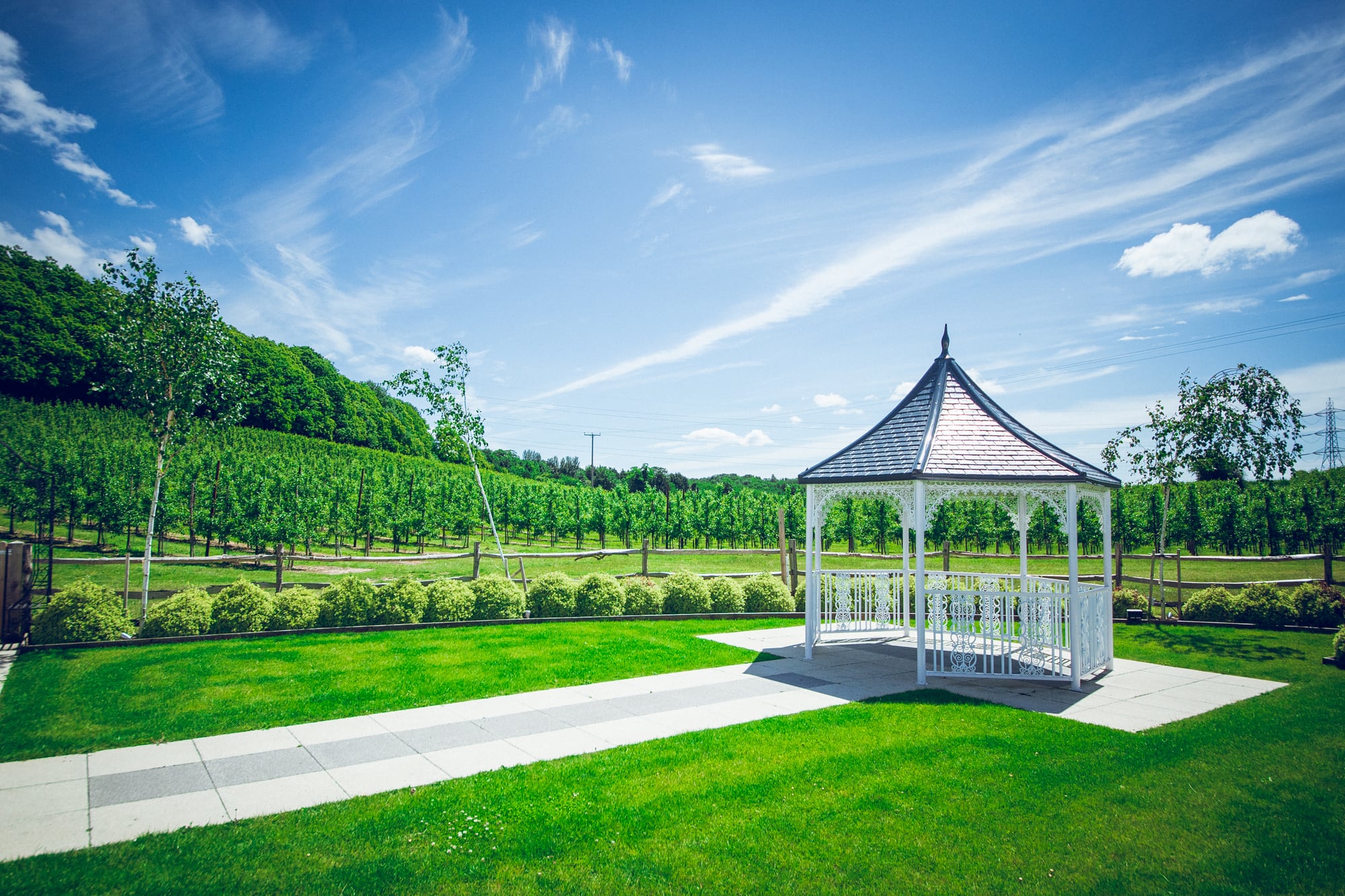
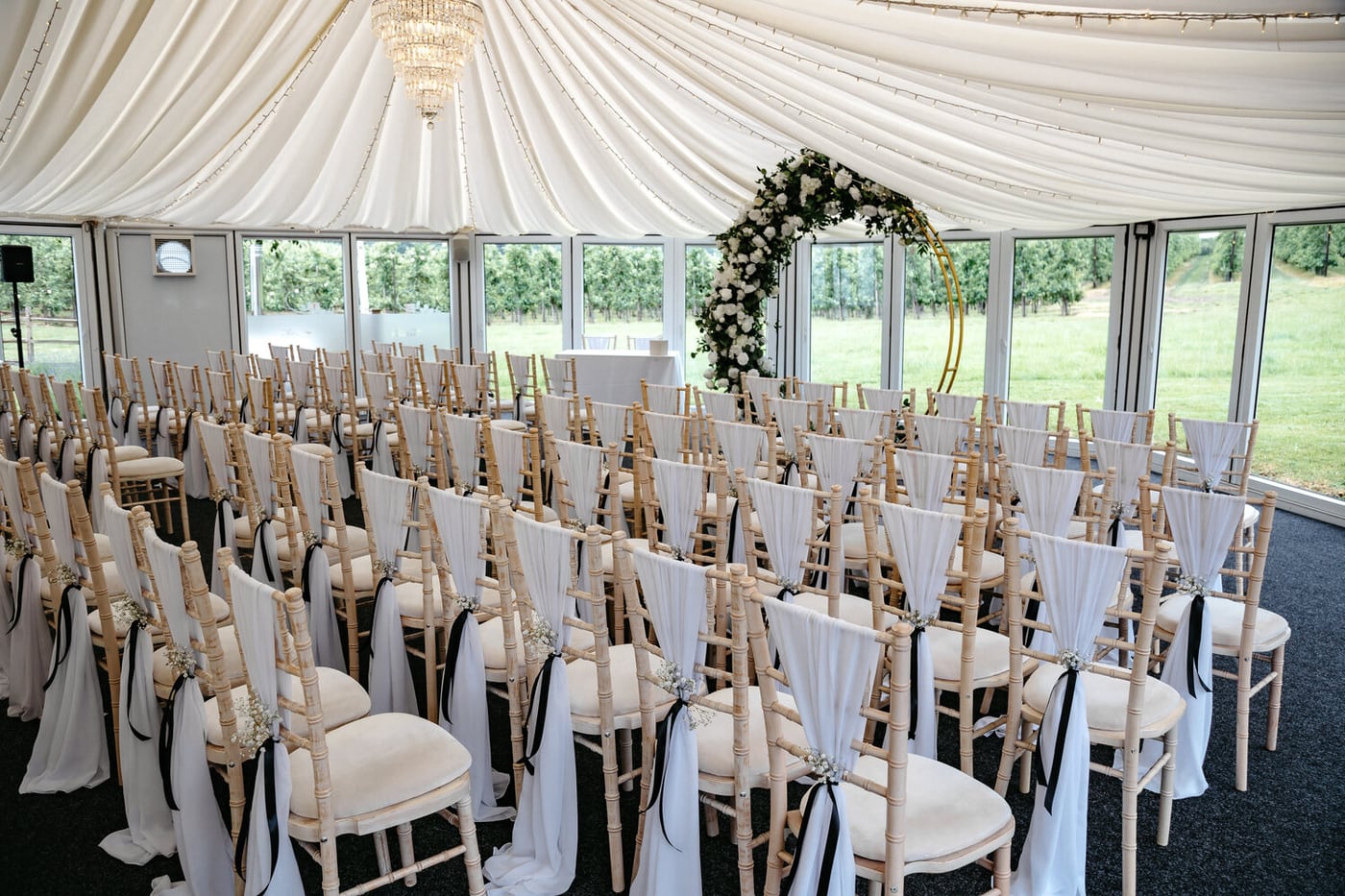
Both gazebos are licensed outdoor settings, so the legal ceremony itself can happen outside rather than only the photographs. If the weather turns, the ceremony moves to the dedicated indoor ceremony area within The Arboretum, which has curved bi-folding glass doors and the same views out across the orchards. The decision is made on the day, and the ceremony goes ahead either way.
There is a second option. Couples who would rather move into the Apple Barn, with its oak beams and fairy lights, can book it as their wet-weather setting for an additional fee, over and above the Arboretum's indoor area, which is included. It suits a winter date in particular, and it means the plan you are happy with is one you chose.
The honest test we would apply anywhere, including here, is this: would you be content if the indoor option were the plan from the start? If the answer is no, you have not got a wet-weather plan, you have got a gamble. Full details of the five settings are on the civil ceremonies page.
PracticalPlanning an outdoor ceremony properly
What should you tell your guests?
That it is outdoors, on the invitation, in plain words. Heels sink into grass. Older guests need shade in July as much as shelter in October. A guest who knew in advance brings a jacket and wears sensible shoes, and a guest who did not spends your ceremony being uncomfortable. It costs one line of text.
What else is worth arranging?
Shade and shelter are the two most-forgotten things, and they are the same problem in different weather. Somewhere for elderly guests to sit out of direct sun matters as much in high summer as an umbrella does in autumn. Confetti and hair also behave very differently in wind, which nobody thinks about until the day.
Does the time of day matter?
Yes, more than people expect. Afternoon showers are more common than morning ones in summer, and light in the hour before sunset is far better for photographs than midday glare. An outdoor ceremony at two o'clock in July is the most exposed slot in the calendar for both heat and rain.
None of this is a reason to give up on marrying outside. It is the most memorable way to do it, and Kent gives you a genuinely reasonable chance of a dry one for a good half of the year. Choose your month for how the place looks and how much it costs, ask the four questions above, and let the forecast do what it likes.
Related reading: how far ahead couples actually book, which covers how the seasons affect price and availability, and the legal side of getting married in Kent.
Quick answersCommon questions
What are the chances of rain on a wedding day in Kent?
Higher than most people hope. Using Met Office averages for East Malling (1991 to 2020), even July, the driest month, sees rain on about 24 per cent of days. There is no month in Kent where you can plan on it being dry.
Which is the driest month for a wedding in Kent?
July, at roughly 24 per cent of days with 1mm of rain or more, followed closely by June and September. The differences between the summer months are small, which is why choosing a month for the weather alone is a weak reason.
Is September a risk for an outdoor wedding?
Less than people assume. September records slightly fewer rain days than August on the Met Office averages, while costing less and being easier to book. It is the month we most often suggest to couples set on an outdoor ceremony.
What does a rain day actually mean?
The Met Office counts a day with 1mm of rain or more. That can be a ten minute shower at seven in the morning rather than rain during your ceremony, so the real odds of rain falling during a 30 minute slot are far lower than the monthly figure suggests.
Can you get married outdoors at The BarnYard?
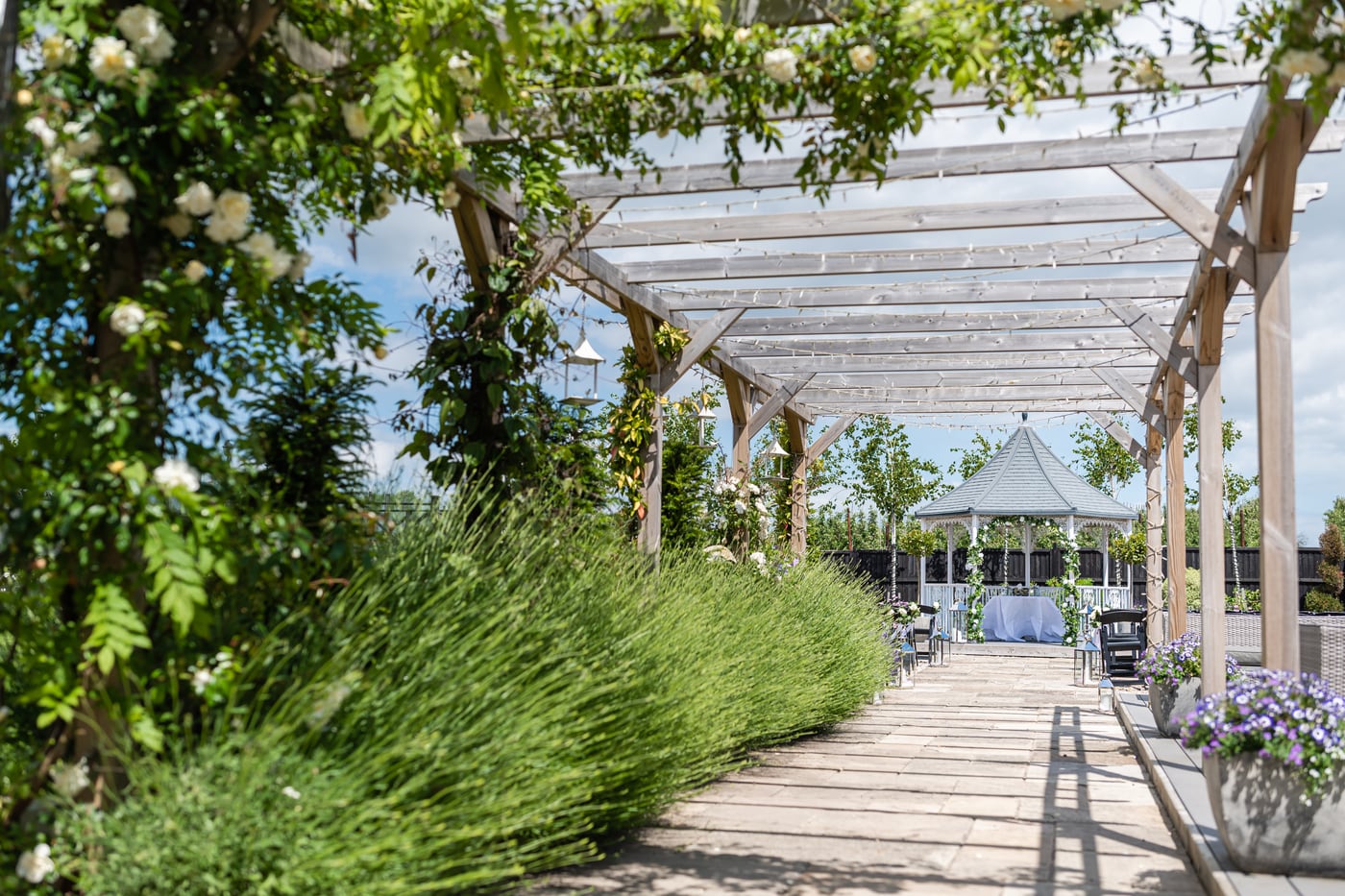
Yes. Three of the five ceremony settings are outdoors: the Lavender Walk Gazebo with its aisle beneath wisteria and rose, the Orchard Garden Gazebo with views across the orchards, and the festoon-lit Courtyard framed by the original barns.
What happens if it rains on the day?
Your ceremony moves to the dedicated indoor ceremony area within The Arboretum, which has curved bi-folding glass doors and the same orchard views, and that is included. If you would rather move into the Apple Barn instead, it can be booked as your wet-weather setting for an additional fee. Either way the ceremony goes ahead, and the decision is made on the day rather than the week before.
When do you have to decide whether to go outside?
On the day itself, once the weather is actually doing something. Ask any venue this directly: a venue that needs 48 hours notice is asking you to gamble on a British forecast, which is not a decision anybody should have to make on the Thursday.
Are outdoor ceremonies legal in England?
Yes, at licensed outdoor settings. Both of our gazebos are licensed for civil ceremonies, which is what allows the legal ceremony itself to happen outside rather than only the photographs.
What should you tell guests about an outdoor ceremony?
Tell them it is outdoors, on the invitation. Heels sink into grass, older guests need shade or shelter, and a guest who knew in advance brings a jacket. It costs you a line of text and prevents most of the problems.
Written by The BarnYardat Upchurch, Kent
