
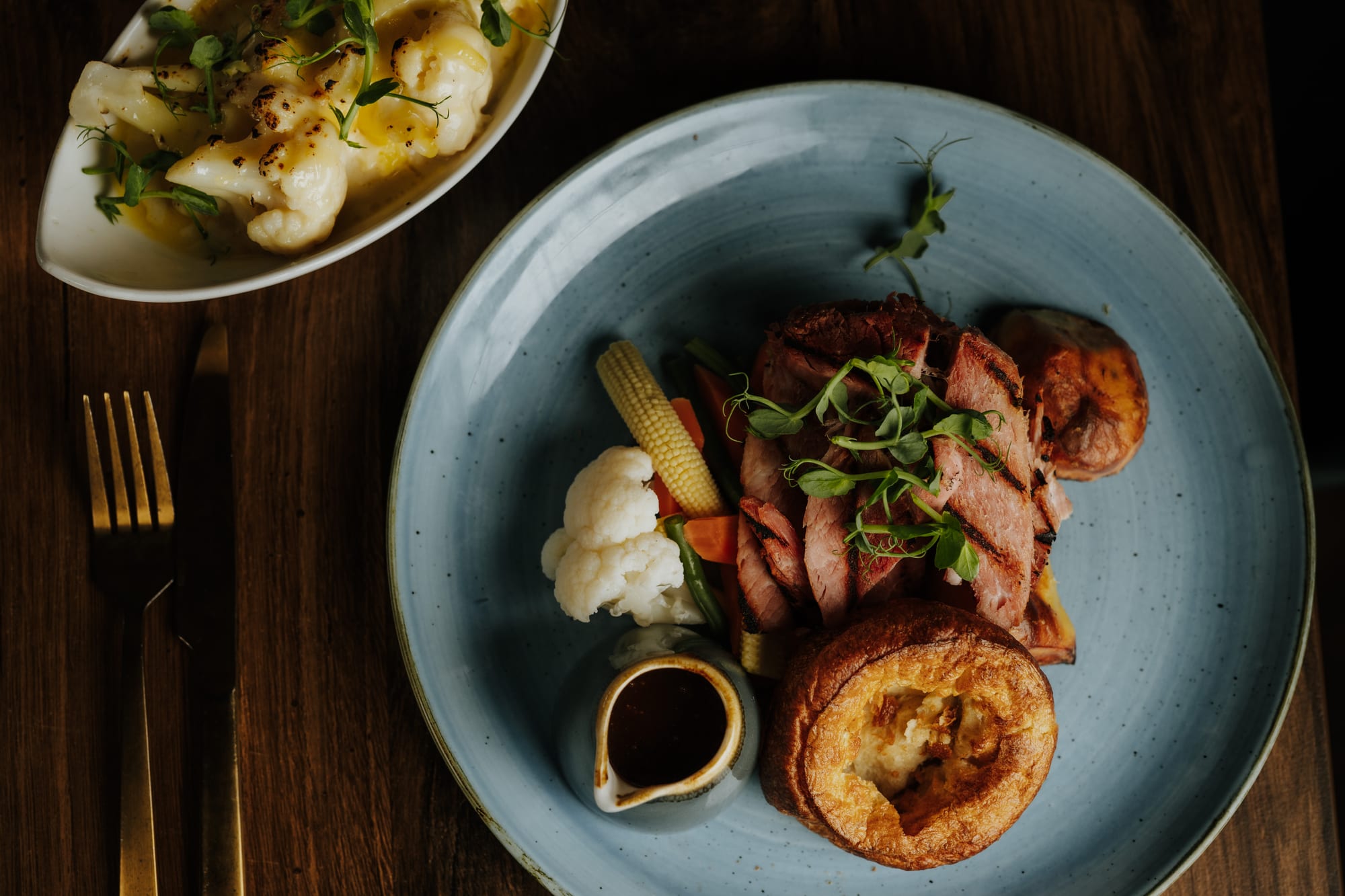
There is a particular disappointment that belongs only to a bad Sunday roast. You have given up the best part of the week, everybody has made an effort, and what arrives is grey beef, a Yorkshire pudding from a packet and gravy that tastes of salt and nothing else. It did not need to happen. A good roast is not difficult, it is just harder to fake than most menus, which is precisely why it is worth knowing what to look for.
This is a guide to telling the difference before you sit down. Some of it is about the food. A fair amount of it is about how a kitchen behaves, because the shortcuts a place takes on a Sunday tend to show up in ways you can spot from the other side of the room. We have also put our own numbers in, from 886 days of service, because "you should probably book" is a weaker answer than telling you exactly how many Sunday tables are walk-ins.
We have run a restaurant at Upchurch since 1984, which means several thousand roasts. We are not neutral. But nothing below is about persuading you to come here rather than somewhere else in Kent, and there is not a word of criticism aimed at anywhere by name. Most of it will help you pick a better roast wherever you end up.
The honest bitWhat a proper roast actually involves
What should a Sunday roast include?
A roast should arrive with meat that was cooked as a joint, potatoes roasted in fat until the outside has gone properly crisp, a Yorkshire pudding, at least two or three vegetables that still have some structure, and gravy made from the pan the meat came out of. That is the whole specification. Everything beyond it is decoration, and everything short of it is a shortcut.
The reason this list matters is that each item is a place where time can be saved. Meat can be cooked days ahead and sliced cold. Potatoes can be parboiled, frozen and finished from a bag. Yorkshire puddings arrive by the case. Vegetables can sit in a hot cabinet for an hour. Gravy can come from a tub of powder. None of that is illegal and some of it is common. It simply produces a worse lunch.
Why does the beef matter more than anything else?
Because beef is the hardest thing on the plate to rescue. A slightly dull carrot is a slightly dull carrot. Beef that was roasted on Friday, chilled, sliced and reheated in gravy is unmistakable, and no amount of good gravy hides it. If a kitchen is going to cut a corner, this is the corner that tells you most about the rest of the kitchen.
Look at the edge of the slice. Meat carved from a joint that is resting has a soft, slightly irregular edge and a gradient of colour from the outside in. Meat that was chilled and machine-sliced has a hard, flat edge and one uniform colour all the way through. You can see it before you taste it.
Reading the roomHow to spot the shortcuts
How can you tell if a roast was cooked fresh?
Order at the beginning of service and see how long it takes. A kitchen carving to order takes a few minutes longer at 12:15pm than one plating from a hot cabinet, and that wait is a good sign rather than a bad one. Food that appears in ninety seconds on a Sunday has been sitting somewhere.
The second tell is variation. If four roasts arrive at your table and every plate is identical to the millimetre, they were assembled. Real plating by real people at speed produces small differences, and those differences are reassuring.
What does a bad Yorkshire pudding tell you?
More than it should. A bought-in Yorkshire pudding is uniform, pale gold, perfectly circular and hollow in a way that feels engineered. A made one is uneven, darker at the edges, and no two are quite the same shape. The pudding itself is a small thing. What it tells you is whether the kitchen makes batter on a Sunday morning, and a kitchen that does that usually makes the gravy too.
Should the vegetables be on the plate or served separately?
Separately, if the kitchen has any confidence. Vegetables in a dish in the middle of the table have to hold up to being looked at, and they have to be hot when they arrive because they are not buried under gravy. It is a small act of exposure. It also means you get the amount you want rather than the amount somebody decided for you.
There is no rule here, and plenty of excellent roasts arrive fully plated. But a separate dish of vegetables is a mild signal in the right direction.
The gravy questionWhy one jug settles the argument
What should gravy actually taste like?
Like the meat it came from, first, and salt second. Gravy made from a roasting pan carries the flavour of whatever was in that pan, so beef gravy and chicken gravy should taste noticeably different from one another. Powdered gravy tastes broadly the same whatever it is poured over, because it is broadly the same thing.
The other test is what happens as it cools. Real gravy thickens slightly and clings to the plate. Powdered gravy tends to stay exactly as it was, or separates into a skin and a puddle.
Is a gravy jug a good sign?
Usually, yes. A jug means the kitchen is happy for you to see the gravy on its own and to use as much or as little as you like. Gravy already poured over everything can be generosity, and often is. It can also be cover. The jug is not proof of anything, but it is a kitchen choosing the harder option.
Choosing wellWhich roast to order
Most places offer three or four meats and most people order the one they always order. That is a perfectly good system. But each meat fails in a different way, and knowing which way is useful when you are somewhere new.
Is beef always the right choice?
Beef is the benchmark, and it is the one to order if you want to judge a kitchen. It is the hardest to hold, the hardest to reheat and the least forgiving of being cooked too far ahead. A kitchen that serves good beef on a Sunday is almost certainly doing everything else properly too.
It is also the one most worth asking about. Beef cooked to medium and rested will be pink through the middle and give slightly under the knife. If you are offered a choice of how you would like it, that is a strong sign, because it means the joints are going in throughout service rather than all at eight in the morning.
What should you look for in roast pork?
The crackling, and only the crackling. Pork itself is fairly forgiving, but crackling cannot be faked, cannot be held and cannot be rescued once it has gone soft. Crisp, blistered crackling that shatters means the pork came out of the oven recently. Chewy crackling means it has been sitting, no matter how good the meat underneath is.
Is roast chicken a lesser option?
No, though it is treated as one. Chicken is the most commonly disappointing roast because it dries out faster than anything else on the menu and its dryness is easy to disguise under gravy. A good roast chicken, properly rested with the skin still crisp, is genuinely excellent, and it tends to be the cheapest thing on the menu. If you trust the kitchen, it is often the best value on the plate.
What does a good vegetarian roast look like?
Something that was actually cooked, rather than the meat roast with the meat removed. A plate of vegetables and a Yorkshire pudding is not a vegetarian roast, it is a side dish with ambitions. Look for a proper centrepiece, its own gravy that is genuinely meat-free, and cauliflower cheese that has not been made with a stock that rules it out.
The gravy point catches people out more than any other. If you are vegetarian, it is always worth asking, and any kitchen worth eating in will know the answer straight away.
Our own numbersWhat a Sunday actually looks like here
Most restaurants tell you Sunday is busy and leave it there. We looked at 886 days of actual service between February 2023 and August 2026 and counted, because the specific numbers answer questions that "we get busy" does not.
How much busier is Sunday than the rest of the week?
Sunday runs at a little over double the pace of any other day we open, and it is not close. That holds across three and a half years rather than being a good month or a warm summer. It is the reason Sunday behaves differently to the rest of our week in almost every respect that matters to you.
This matters to you for one practical reason. A kitchen doing double its normal volume has no spare capacity for improvisation, which is why the requests you make in advance are far easier to honour than the ones you make at the table.
Do you actually need to book for Sunday lunch?
Yes. Across those 886 days, 89 per cent of our Sunday tables were booked in advance and only 5 per cent were walk-ins. That is not a policy, it is just what happens. Nine in ten people who eat a Sunday roast here decided to do it beforehand, and the remaining tables go early.
If you want a specific time, the middle of service between 12:30pm and 1:30pm goes first. Later tables, from about 2pm, are usually the last to be taken and are noticeably calmer. You can book a table here.
How long should you allow for Sunday lunch?
Two hours is right. The median Sunday sitting here is 106 minutes, so a table at 1pm is generally finished a little before 3pm. If you are a group of eight, or you intend to have dessert and coffee and sit about afterwards, allow longer and say so when you book.
Which sitting should you book?
The middle of service, between 12:30pm and 1:30pm, is the first to fill and the busiest to sit in. It is also the peak of the kitchen, which cuts both ways. Food is flowing and nothing is standing about, but the room is loud and the pace is quick.
From about 2pm onwards it is noticeably calmer, tables are easier to get at short notice, and the service is more relaxed. If you are bringing somebody elderly, or a small child, or you simply want to hear the conversation, the later sittings are the better bet. The one thing to check anywhere, not only here, is what the last sitting means in practice, because a kitchen serving roast very late in the afternoon is either exceptional at managing it or is holding food.
The practical bitsTimes, dogs, children and getting here
What time is Sunday lunch served?
From 12:00pm to 3:30pm. The restaurant itself opens at 9am, and breakfast runs until 11:30am, so there is a short gap in between while the kitchen changes over. We close at 4pm, and we are open Wednesday to Sunday. If you are planning a walk first, plan it for the morning rather than the afternoon, because there is no evening service to come back to.
Can you bring a dog?
Into the Courtyard, yes. The Courtyard is the enclosed outdoor terrace just outside The Rooster, and dogs are genuinely welcome there. Dogs are not allowed inside the main buildings, so this is a fine plan in May and a much less appealing one in January. It is worth being straight about that rather than letting you arrive in the rain and find out.
Can you bring children?
Yes, and smaller portions are available. Mention it when you book so we can put you somewhere sensible and have highchairs ready. On a full Sunday, where you are seated makes a real difference to how relaxed lunch feels with a toddler.
Where exactly are you?
Oak Lane, Upchurch, Sittingbourne, Kent ME9 7EZ. That is about five minutes from Rainham, twelve from Sittingbourne, fifteen from Gillingham, twenty from Chatham and twenty-five from Maidstone, coming off the A249 and the M2. Parking is free and on site, which on a Sunday is less trivial than it sounds.
A table for eightSunday lunch as an occasion
Birthdays, christenings and the sort of family Sunday that has been arranged by text message for a fortnight all tend to land on a roast. Groups behave differently to couples, and it is worth planning slightly harder.
How big a group can you book for Sunday lunch?
The Rooster, our restaurant dining room, seats up to 50 across the room. The Mezzanine, the private space directly above it, takes up to 24 and is the better option for a group that wants to talk without competing with a full room. The Mezzanine is upstairs and is not suitable for wheelchair users, so if that matters, say so when you book and we will arrange something downstairs.
Beyond about 24, a Sunday lunch stops being a restaurant booking and starts being an event, and it moves across to a different part of the venue with its own spaces and menus. That is a better outcome than squeezing thirty people into a dining room on the busiest day of the week.
What should you sort out in advance for a group?
Numbers, allergies, whether you want a set menu, and roughly what time you would like to eat rather than arrive. On a day running at double the usual pace, a group that has pre-ordered eats together and comfortably. A group of twelve ordering individually at 1pm on a Sunday will wait, and will probably not all be served at once, however hard everybody tries.
None of this is unique to us. It is worth asking anywhere, because the answer tells you whether a kitchen has thought about groups at all.
Ours, plainlyWhat we serve and what we do not
What is on the Sunday menu?
A roast with the things a roast should have, cooked by the same kitchen that caters our weddings, using locally sourced ingredients and produce from the surrounding land where the season allows. We sit in 150 acres of apple and pear orchards, and that shows up in the food more at some times of year than others. The current menus are on the menus page.
There is always a vegetarian roast. Allergies and dietary requirements are handled by the kitchen directly, and again, telling us when you book is far better than telling us at the table on the busiest day of our week.
What should you drink with a roast?
Whatever you like, though there is a reason red wine and roast beef became a habit. A medium-bodied red has enough acidity to cut through fat and gravy without overwhelming the meat. With pork or chicken, a white with some weight to it works better than something very crisp. With lamb, almost anything red is fine.
Two practical notes. We do not permit outside alcohol and we do not offer corkage at any price, so a bottle brought from home is not an option. If there is something specific you want for a celebration, the bar can usually order it in provided you ask when you book rather than on the day. And because there is no evening service, a bottle over Sunday lunch is a genuinely leisurely thing rather than a rushed one.
What we do not do
We do not allow outside alcohol and we do not offer corkage, at any price. The bar is stocked and priced sensibly, and if there is a particular bottle you want for a birthday we can usually order it in if you ask in advance. We also do not do evening service, so Sunday lunch here is genuinely lunch.
And the restaurant is a working part of a wedding venue. Most Saturdays and many Sundays there is a wedding happening elsewhere on the site, in the Arboretum or the Apple Barn. You will not be in it and it will not be in your lunch, but you may well see a bride crossing the courtyard, which most people seem to enjoy.
The rest of the weekIf Sunday does not suit
Sunday is the busiest day we have by a wide margin, and for some people that is precisely the appeal. A full room on a Sunday has an atmosphere that a quiet Wednesday cannot manufacture. For others it is the reason to come on a different day, and there is a good case for that too.
What else does the kitchen do during the week?
Breakfast runs from 9am to 11:30am, Wednesday through to Sunday, and it is the most underrated thing we serve. Lunch follows on and the restaurant closes at four. The same kitchen that cooks the roasts cooks all of it, and the same kitchen caters the weddings that happen elsewhere on the site, which is unusual and is the reason the standard holds up across a week rather than peaking once on a Sunday.
High tea is served Wednesday to Sunday and needs booking ahead, because a full afternoon tea takes over a good part of the room. The seasonal versions run on set dates, and those sell out; what is on the stands is on the high tea page, and they do sell out well ahead.
Is a weekday lunch actually better?
It is different rather than better. Midweek runs at well under half the pace of a Sunday, so the room is calmer, tables are easier to come by at short notice, and there is more time for anybody to talk to you. If you are bringing somebody who finds a busy room hard work, or you want to sit for three hours over lunch without feeling the pressure of a table booked behind you, midweek is the honest recommendation.
Where you are sittingThe bit that is not on the plate
A roast is partly about the food and partly about the two hours it occupies, which is the argument for eating one somewhere that is worth looking at. We are biased about this, but the setting does a reasonable amount of the work on a Sunday.
What is around the restaurant?
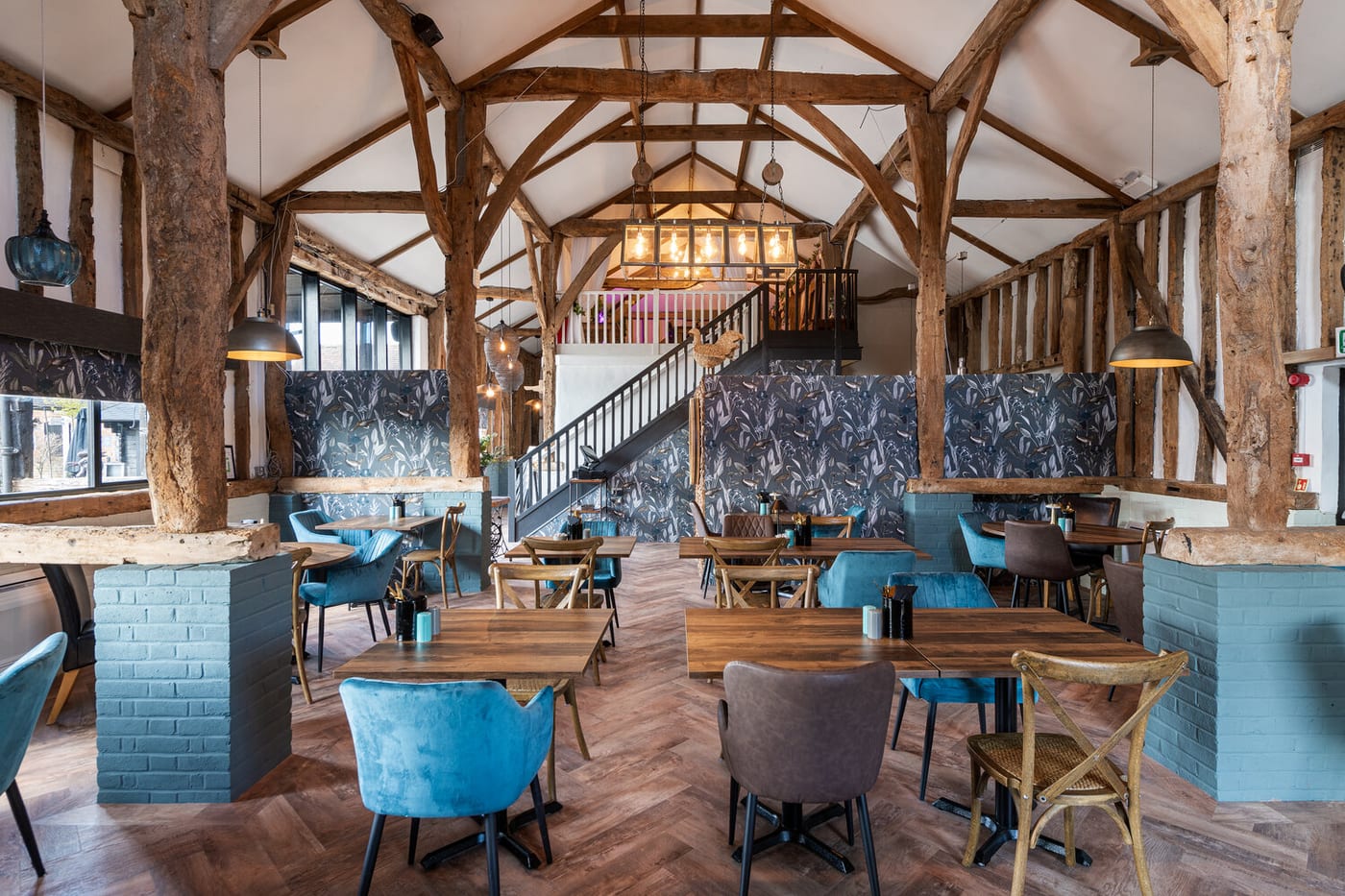
The BarnYard sits in 150 acres of apple and pear orchards on the edge of Upchurch, with the Medway estuary a short walk north and open farmland in most other directions. The dining room is a genuine oak-beamed barn rather than a room decorated to look like one, and the Courtyard outside it is enclosed, planted and festoon-lit, which makes it usable far later into the autumn than people expect.
The practical version of this is that a Sunday here absorbs a morning as well as a lunch, if you want it to. Walking first and eating afterwards is a better order than the reverse, and it also solves the problem of what to do with a dog, since the Courtyard is where they are welcome and the orchards are on the doorstep.
Is it worth making a morning of it?
For most people, yes, and it costs nothing to do so. The footpaths around Upchurch and Lower Halstow are flat, well marked and quiet, and the Saxon Shore Way runs along the estuary within a couple of miles of the front door. A walk that finishes at half past eleven leaves you exactly enough time to sit down for the start of roast service.
The one thing to plan around is the closing time. We stop serving at four and there is no evening, so this works as a morning and a lunch and does not stretch into a whole day. Plan accordingly and it is one of the better ways to spend a Sunday in this part of Kent.
Before you book anywhereFour questions worth asking
These work on any restaurant in Kent, including this one. The answers tell you more than a menu does.
- Is the beef carved to order? A kitchen that carves to order will say so immediately and with some pride. Hesitation is itself an answer.
- Are the Yorkshire puddings made here? Same principle. It is a question nobody minds being asked.
- How long is the table for? Worth knowing before you arrive. Two hours is normal and reasonable. Ninety minutes on a roast is tight.
- What time does the roast run until? Kitchens that serve roast until late afternoon are either very good at holding food or are holding food. Ask what happens if you book the last sitting.
None of this is complicated, and the point is not to turn lunch into an inspection. It is that a roast is one of the few meals where the difference between care and convenience is visible from your seat, and knowing where to look means you are far less likely to give up a Sunday for a disappointing one.
If you would rather come on a quieter day, we serve breakfast and lunch from Wednesday, and high tea Wednesday to Sunday, booked ahead. If you are thinking about something larger, a christening lunch or a big birthday, that sits with our events team instead. And if you simply want the practical details in one place, they are on the everything explained page.
Quick answersCommon questions
What time is Sunday lunch served at The BarnYard?
Sunday roast is served from 12:00pm to 3:30pm. The restaurant opens at 9am for breakfast, which runs until 11:30am, and closes at 4pm. We are open Wednesday to Sunday.
Do you need to book for Sunday lunch?
Yes, in practice. Across 886 days of trading, 89 per cent of our Sunday tables were booked in advance and only 5 per cent were walk-ins. Sunday is more than twice as busy as any other day we open, so arriving without a booking is a gamble.
How long should you allow for Sunday lunch?
Around two hours. The median Sunday sitting at The BarnYard is 106 minutes, so a table booked at 1pm is usually finished a little before 3pm. Allow longer if you are a large group or you want dessert and coffee.
How much busier is Sunday than the rest of the week?
A little over twice as busy. Sunday runs at more than double the pace of any other day we open, which is why tables go early and why the kitchen has far less room to improvise on the day.
Can you bring a dog to Sunday lunch?
Dogs are welcome in the Courtyard, the outdoor terrace just outside The Rooster, where they can join you for alfresco dining. Dogs are not allowed inside the main buildings, so plan for the weather if you are bringing one.
Is the restaurant wheelchair accessible?
Yes. Wheelchair access is through The Roost entrance and all areas are accessible with one exception. The Mezzanine is upstairs and is not suitable for wheelchair users, so mention it when you book and we will seat you downstairs.
Do you charge for children at Sunday lunch?
Children are welcome and there are smaller portions available. Ask when you book so we can seat you somewhere sensible and have highchairs ready.
Can you bring your own wine, and is there corkage?
No. We do not allow outside alcohol and we do not offer corkage. The bar is fully stocked and competitively priced, and if there is a particular bottle you want for a celebration we can usually order it in if you ask when booking.
Where is The BarnYard and is there parking?
Oak Lane, Upchurch, Sittingbourne, Kent ME9 7EZ. It is about five minutes from Rainham, twelve from Sittingbourne, fifteen from Gillingham and twenty-five from Maidstone, just off the A249 and the M2. Parking is free and on site.
Can you cater for vegetarians, vegans and allergies?
Yes. There is always a vegetarian roast option, and the kitchen handles allergies and dietary requirements directly. Tell us when you book rather than on the day, because a Sunday kitchen at full tilt has far less room to improvise.
Written by The BarnYardat Upchurch, Kent
