
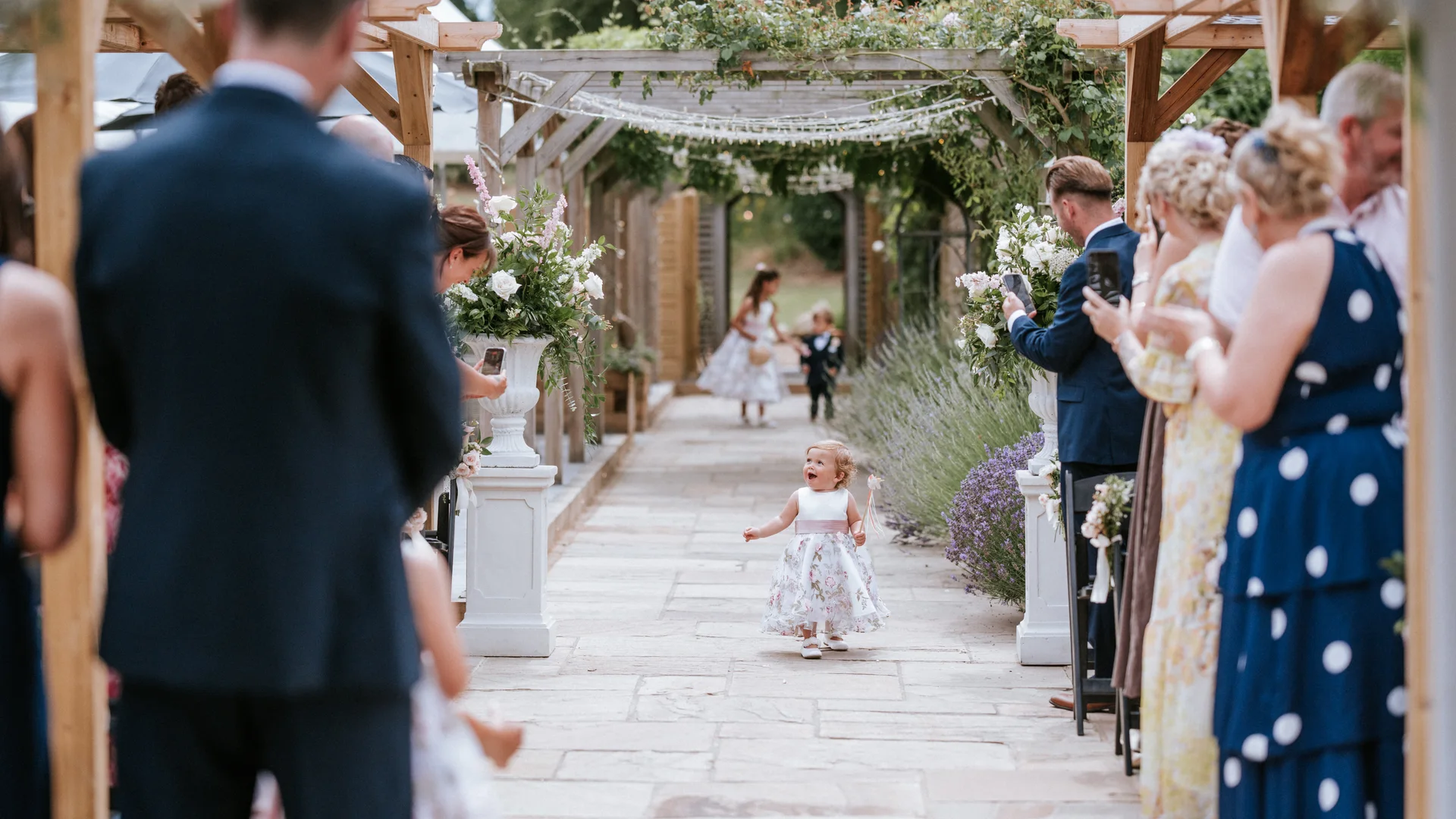
Before you choose a venue, a date or a dress, there is a quieter decision underneath them all: what kind of ceremony do you actually want? For most couples in England the realistic choice is between a civil ceremony and a church wedding, and it shapes everything from the paperwork you file to the words you say. Both end with you married. They get there quite differently. Here is an honest comparison to help you work out which is right for you.
A quick note on who is writing this. The BarnYard is a licensed civil ceremony venue in Kent, so we naturally see more of one side than the other. But plenty of couples we meet are still deciding, some choose a church, and this guide is written to be genuinely useful whichever way you lean.
The legal heart of the dayWhat a civil ceremony actually is
What is a civil ceremony?
A civil ceremony is a legally binding marriage or civil partnership conducted by a registrar rather than a member of the clergy. It takes place at a register office or at a venue licensed for ceremonies, and since a change in the law in 2021, made permanent in 2022, it can also happen outdoors in the grounds of a licensed venue, which is why gazebo and garden ceremonies are now such a fixture of English weddings.
The legal core of the ceremony is short: a few statutory declarations, the exchange of vows, and the signing of the schedule in front of two witnesses. Around that core, the ceremony is yours to build. Personal vows, readings by friends and family, the music you walk in to, the song you sign to. A typical civil ceremony runs 20 to 40 minutes depending on how much you add.
What can you not include in a civil ceremony?
The one firm rule is that a civil ceremony cannot include religious content. No hymns, no prayers, no religious readings. Your registrar will advise on anything borderline, and a song that happens to mention heaven is usually judged sensibly on context. If faith is part of your life but a church wedding is not the right fit, some couples pair a civil ceremony with a separate blessing arranged in their own time.
Civil ceremonies are open to all couples, including same-sex couples, which is worth naming plainly because the Church of England does not currently marry same-sex couples.
Vows before the altarWhat a church wedding involves
What does a church wedding involve?
A Church of England wedding is both a religious service and a legal marriage in one. The service follows a set liturgy, led by the vicar, with hymns, prayers and readings woven through it. The legal side is completed in church as part of the service, you sign the marriage document there and then, and the vicar handles the paperwork afterwards, so there is no separate trip to a register office on the day.
You generally marry in your own parish church, or in a church where you have what the Church calls a qualifying connection: you have lived in the parish, you worship there, your parents or grandparents were married there, and so on. Many couples find that connection is easier to establish than they expected, and vicars are used to the question.
Instead of giving notice at a register office, a Church of England wedding is usually preceded by the reading of banns, your intention to marry announced in church on three Sundays in the three months before the wedding, in your own parish and the parish where you will marry. Where banns cannot be used, the church can advise on marrying by licence, or, if one of you is not a British or Irish citizen, you will give notice at the register office instead, just as for a civil ceremony. It is worth knowing that this route is specific to the Church of England and the Church in Wales. Weddings in other churches and religious buildings usually require you to give notice at the register office as well, just as a civil ceremony does.
Forms firstThe legal steps, side by side
What are the legal steps for each?
For a civil ceremony, you each give notice of marriage at your local register office at least 29 days before the ceremony. It is a short appointment where you confirm who you are and where you will marry, and the notice is valid for twelve months. If you marry at a licensed venue such as The BarnYard, the ceremony itself is booked with the registration service for the area, which for us means the Kent Registrars. We make that booking on your behalf, and giving notice near home is the one legal errand left on your list.
For a Church of England wedding, the banns usually take the place of civil notice, and hearing them read is a small tradition in its own right. You will meet the vicar beforehand, often several times, and many churches include some form of marriage preparation, which couples tend to find more valuable than they expected.
Either way, the legal requirements on the day are the same in spirit: declarations, vows, two witnesses, a signature. Nobody has ever had a worse wedding because the paperwork was straightforward.
One venue or twoThe shape of the day
Does it mean one venue or two?
This is the practical difference couples feel most. A church wedding usually means two locations: the service in church, then the whole guest list moving to a reception venue. That brings a convoy of cars, a gap in the day to manage, and timings that depend on Kent traffic behaving itself. None of it is a dealbreaker, thousands of couples do it beautifully every year, but it needs planning, and it eats into the time you spend with your guests.
A civil ceremony at a licensed venue keeps everything in one place. You can get ready on site, marry in the garden or the barn, and walk straight from your vows to your canapés while the photographer catches the light. At The BarnYard that whole arc happens within one estate: ceremony at the Lavender Walk gazebo or the Orchard Garden gazebo, drinks in the gardens, dinner and dancing in the Arboretum, with no travel and no gap to fill.
The counterweight is the building itself. If you love a particular church, its history, its bells, the fact that your parents married there, no licensed venue replicates that, and it would be dishonest to pretend otherwise. A fifteenth-century nave is its own argument.
The honest numbersWhat each one costs
Which one costs more?
Neither route is expensive compared with the rest of a wedding, and neither should decide this for you, but for completeness: civil ceremony fees are set by the local registration service and vary with the day of the week and the setting, and at a licensed venue they are paid directly to the registrars, separate from anything the venue charges. Church of England wedding fees are set nationally each year and paid to the church, with extras such as an organist, a choir or bells costing more. In both cases you are typically in the hundreds of pounds, not the thousands, and both the registrars and any vicar will tell you the exact figures upfront.
The venue, the food and the party cost what they cost in either scenario. If you are budgeting properly, our guide to what a BarnYard wedding actually costs breaks that side down honestly.
Heart and headHow to decide
How do you actually decide?
Strip away the logistics and the decision usually answers itself. A church wedding is right for you if faith is part of your life together, if the traditional liturgy moves you, if hymns sung by a full congregation is the sound you imagine when you picture the day, or if a particular church holds your family's history. Those are wonderful reasons and no venue should talk you out of them.
A civil ceremony is right for you if you want the whole day in one place, if you want to write your own vows and choose every word and every song, if you would rather marry under open sky than under a roof, if you are a same-sex couple, or simply if religion is not part of your story and you want a ceremony that is honestly, comfortably you.
And if you are torn, talk to both. Sit down with a vicar and visit a licensed venue in the same week. One of those two conversations will usually settle it.
If you choose civilHow it works at The BarnYard
How does a civil ceremony work at The BarnYard?
Ceremonies here are conducted by a registrar from the Kent Registrars in settings licensed for up to 200 guests. Full-day weddings choose from five: the Lavender Walk Gazebo, approached along a stone aisle beneath wisteria and roses; the Orchard Garden Gazebo, looking out across the apple and pear orchards; the festoon-lit Courtyard, framed by our original barns; a dedicated indoor ceremony area within the Arboretum, our glass pavilion; or the fairy-lit Apple Barn itself, for an additional charge from £750. Twilight and Intimate weddings marry in the Apple Barn or out in the Courtyard, which carries a £250 charge on the Intimate package. If the weather turns, a gazebo ceremony moves to the dedicated ceremony area inside the Arboretum, while Apple Barn and Courtyard ceremonies have the barn itself as their shelter, and the day carries on without a hitch.
We book the ceremony with the Kent Registrars on your behalf, their fee is paid to them directly, and our team reminds you when it is time to give notice at your own register office. You can read about every setting on our civil ceremonies page, or browse real ceremonies in the Apple Barn and the Courtyard to see how each one photographs.
Wherever you land, church or civil, marry in the way that feels like the two of you. Everything else is just planning.
Quick answersCommon questions
What is the difference between a civil ceremony and a church wedding?
A civil ceremony is a legally binding marriage conducted by a registrar with no religious content. A church wedding is both a religious service and, in the Church of England, a legal marriage, conducted by a member of the clergy.
Can you have religious readings in a civil ceremony?
No. A civil ceremony cannot include religious content of any kind. Your vows, readings and music are otherwise entirely your choice, and your registrar will tell you if something you have chosen crosses the line.
Do you give notice for a church wedding?
Not usually. For a Church of England wedding, banns read in church normally take the place of giving notice at a register office. For a civil ceremony you both give notice at your local register office.
Is a civil ceremony less meaningful than a church one?
No, and the question is really about what matters to you. A civil ceremony gives you freedom over almost everything except religious content. A church gives you the building, the tradition and the liturgy.
Does a church wedding mean two venues in one day?
Usually, yes, which means transport, a gap between the service and the reception, and guests moving twice. A civil ceremony at a licensed venue keeps the whole day in one place.
Can same-sex couples have a civil ceremony?
Yes. Civil ceremonies are open to all couples.
Who conducts the ceremony at The BarnYard?
A registrar from the Kent Registrars. We book the ceremony with them on your behalf when you book your date, but their fee is charged directly to you.
Can you have a blessing at the venue after a church wedding?
Yes, and plenty of couples do it the other way round too, marrying legally elsewhere and holding a celebrant-led ceremony here. A blessing carries no legal weight, so none of the notice rules apply to it.
Written by The BarnYardat Upchurch, Kent